Rise
The Company That Put America on Wheels
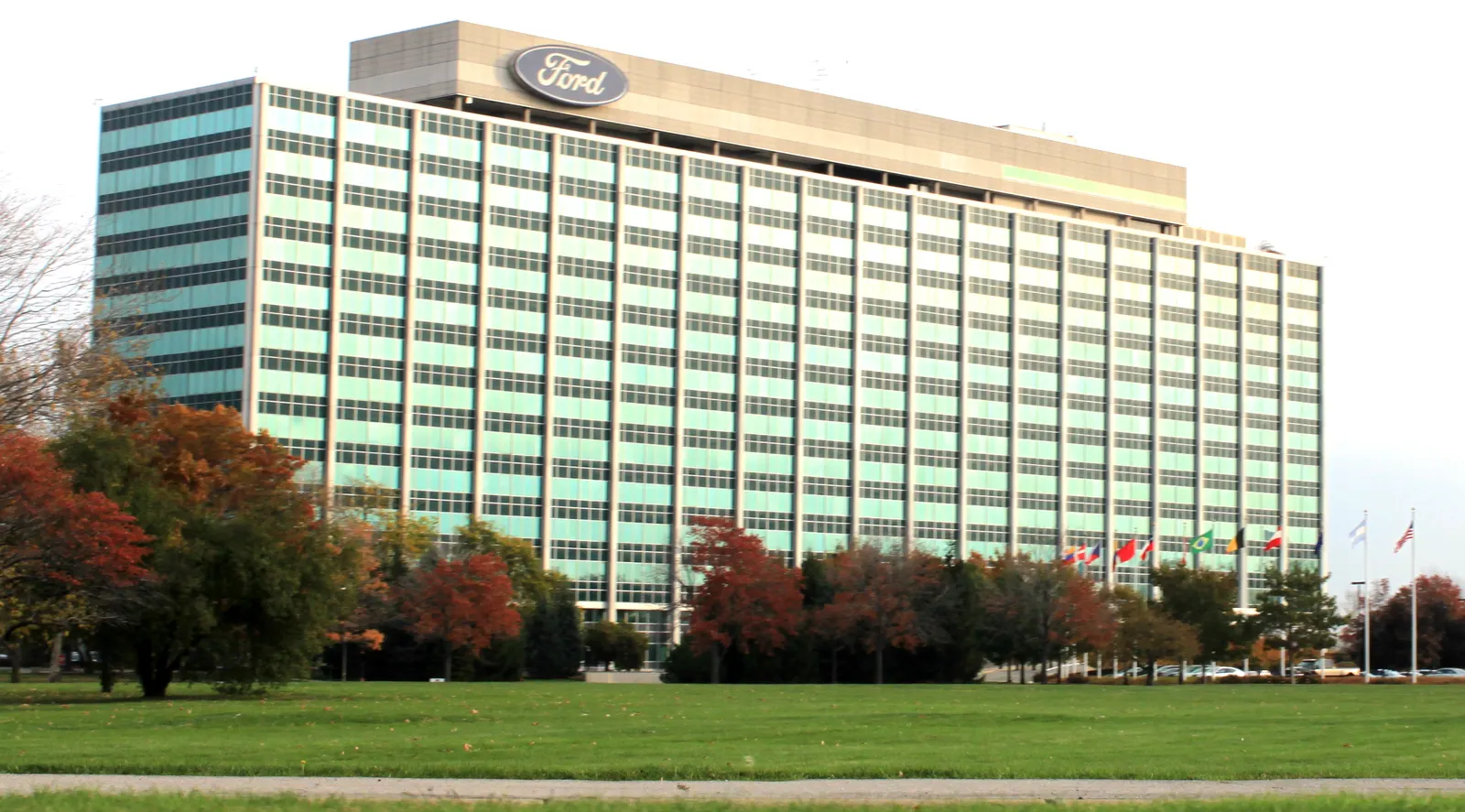
Ford Motor Company, founded by Henry Ford in 1903, transformed the automobile from a luxury good into a mass-market product through the 1908 Model T and the introduction of moving assembly line production in 1913, which dramatically reduced manufacturing costs and made car ownership achievable for a much broader segment of the American population.
Over the following decades, Ford grew into one of the “Big Three” American automakers alongside General Motors and Chrysler, expanding globally and, through the 1990s and 2000s, acquiring a portfolio of prestigious international luxury brands — Jaguar, Aston Martin, Land Rover, and Volvo — grouped under what became known as the Premier Automotive Group.
Fall
A Company Competing Against Itself
By the mid-2000s, Ford’s global operations had become deeply fragmented. Its North American, European, and Asia-Pacific divisions largely operated as independent fiefdoms, frequently developing separate vehicle platforms, engines, and components for similar vehicle segments rather than sharing engineering resources across regions — a duplication of effort that significantly inflated costs relative to competitors with more globally standardized platforms.
The Premier Automotive Group, intended to add prestige and diversify Ford’s brand portfolio, instead consumed significant management attention and capital without generating returns that justified the investment, while Ford’s core namesake brand, the vast majority of its actual sales volume, continued losing market share to Toyota, Honda, and other increasingly competitive import manufacturers.
Internal culture compounded these structural problems: Ford’s executive meetings were widely described as adversarial and status-conscious, with regional and divisional leaders often reluctant to surface problems for fear of appearing weak relative to colleagues competing for the same limited resources and career advancement.
Crisis
A Record Loss, and a CEO From Outside the Industry
The consequences of this fragmentation and eroding market share arrived in full force in 2006, when Ford reported a net loss of approximately $12.7 billion for the year — at the time, the largest annual loss in the company’s history. The scale of the loss made clear that incremental fixes to the existing structure would not be sufficient.
In a decision that surprised much of the automotive industry, Bill Ford Jr., the company’s chairman and a great-grandson of founder Henry Ford, stepped aside as CEO and recruited Alan Mulally, an executive with decades of experience at Boeing but none in the automotive industry, to lead the turnaround. The choice reflected a judgment that Ford needed leadership unattached to the internal politics and divisional loyalties that had entrenched its fragmented structure.
Mulally’s first major action, taken before the broader 2008 financial crisis had even begun, was to secure a $23.6 billion credit facility by pledging nearly all of Ford’s assets as collateral — its factories, its patents, and, in a detail widely cited afterward, its own blue oval logo. The financing was intended to fund the restructuring and build a substantial cash cushion, a decision that would prove decisive two years later.
Turnaround
“One Ford” and the Discipline of Saying “Red”
Mulally’s central strategic framework, known as “One Ford,” aimed to eliminate the duplication and fragmentation across Ford’s regional divisions by consolidating vehicle platforms, engineering resources, and branding around a single, globally coordinated Ford, rather than semi-independent regional businesses each pursuing their own product strategies.
Operationally, Mulally introduced a weekly “Business Plan Review” meeting in which every senior executive presented the status of their area using a simple color code: green for on track, yellow for a concern, and red for a serious problem. In the meetings’ early months, virtually every executive reported green, despite Ford’s well-documented, multibillion-dollar losses — a sign of exactly the fear-driven, information-suppressing culture Mulally was trying to dismantle.
A frequently recounted turning point came when Mark Fields, then head of Ford’s Americas division, reported a red status on a vehicle launch that was genuinely behind schedule. Rather than criticizing Fields, Mulally reportedly applauded the disclosure in front of the full executive team, publicly rewarding the transparency the entire process depended on — a moment credited with meaningfully shifting the broader executive culture toward honest problem reporting in the following weeks.
Strategy
Selling the Prestige Brands to Fund the Core Business
Consistent with the “One Ford” focus, Mulally moved to divest the Premier Automotive Group brands that had consumed disproportionate management attention without commensurate returns. Ford sold Aston Martin in 2007, Jaguar and Land Rover to Tata Motors in 2008, and Volvo to China’s Geely in 2010, systematically returning the company’s full strategic and financial focus to the core Ford brand.
This divestiture strategy freed capital and management bandwidth precisely as the 2008 financial crisis began collapsing industry-wide auto sales, giving Ford’s leadership the ability to concentrate entirely on stabilizing its core North American and global Ford-brand operations rather than simultaneously managing a portfolio of unrelated luxury marques through the same crisis.
The strategy’s most consequential payoff came from timing rather than the divestitures alone: because Ford had already raised its $23.6 billion financing cushion in 2006, well before the 2008 crisis, the company had the liquidity to weather the crash in auto sales without seeking the emergency federal assistance that General Motors and Chrysler required.
“It’s okay to have a plan that’s red. It’s not okay to hide it.”
Leadership
An Outsider Who Changed How Executives Told the Truth
Alan Mulally’s background in aerospace, rather than automobiles, is frequently cited as central to his effectiveness at Ford, echoing a pattern seen in other turnarounds in this collection: an executive without deep roots in the existing organizational culture was better positioned to identify and dismantle dysfunction that industry veterans had come to accept as normal.
Mulally’s specific contribution to Ford’s turnaround was less a novel product strategy than a rebuilt decision-making culture, one where problems could be surfaced honestly and quickly rather than concealed until they became too large to hide. The Business Plan Review process institutionalized that culture through a simple, consistently applied visual system rather than relying on individual executives’ willingness to speak up unprompted.
Bill Ford Jr.’s own decision to step aside as CEO in favor of an outside hire, while remaining actively involved as executive chairman, is itself notable: it required a member of the founding family to conclude that the company’s survival depended on leadership from outside both the company and the industry, a judgment that proved decisive for Ford’s ability to navigate the subsequent crisis independently.
Innovation
Standardizing Platforms Globally
The “One Ford” strategy’s most significant operational innovation was the consolidation of vehicle platforms across Ford’s previously independent regional divisions, allowing the same underlying vehicle architecture to be used for similar models sold in North America, Europe, and Asia, rather than each region engineering separate platforms for broadly similar vehicles.
This standardization reduced engineering and manufacturing costs substantially while still allowing regional variation in styling, features, and marketing to suit local market preferences, letting Ford capture the efficiency of scale without abandoning the ability to compete effectively in different markets’ specific customer preferences.
The Business Plan Review process itself represented a process innovation with effects well beyond Ford’s immediate crisis: a simple, visually clear, non-punitive reporting structure that made organizational problems visible to leadership quickly, a governance approach that has since been referenced and adapted by other large organizations seeking to improve the speed and honesty of internal problem escalation.
Financial Recovery
The Only Detroit Automaker to Avoid a Bailout
Ford’s financial trajectory through the crisis stands in stark contrast to its Detroit peers. General Motors and Chrysler both required federal bailout funds in 2008 and 2009, with GM undergoing a formal Chapter 11 bankruptcy restructuring. Ford, having secured its $23.6 billion financing cushion in 2006, avoided seeking government assistance entirely, a distinction the company’s marketing and public communications emphasized heavily in the years that followed.
Ford returned to profitability in 2009, even as the broader auto industry and U.S. economy remained deeply distressed, and its stock price, which had traded below $2 per share during the worst of the crisis, recovered to over $18 per share by 2010 and 2011 as investors recognized the durability of the “One Ford” restructuring.
The completion of the Premier Automotive Group divestitures by 2010 — Aston Martin, Jaguar, Land Rover, and finally Volvo all sold — left Ford as a more focused, more profitable company than it had been at any point in the preceding decade, validating both the platform consolidation strategy and the earlier decision to raise a large financing cushion before the crisis made such financing far more difficult and expensive to obtain.
Lessons
What Ford’s Turnaround Still Teaches
Ford’s recovery demonstrates the strategic value of raising capital and building financial resilience before a crisis fully materializes, rather than waiting until distress is severe enough to force far more expensive, dilutive, or externally imposed financing terms — the 2006 financing, secured while conditions were still merely bad rather than catastrophic, was the single most consequential decision in the entire turnaround.
The second lesson concerns the cost of internal fragmentation that looks reasonable at the level of any individual regional or divisional decision, but that collectively duplicates costs and diffuses accountability across an organization. The “One Ford” consolidation addressed a problem that had built up gradually over many years of locally rational decisions.
The third lesson is cultural: a turnaround’s success can depend as much on whether an organization can report bad news honestly and quickly as on the specific strategic decisions made in response to that news. Mulally’s Business Plan Review process mattered less for its simplicity than for how directly it rewarded the behavior — honest disclosure — that the prior culture had actively suppressed.