Rise
From a Single Seattle Storefront to the “Third Place”
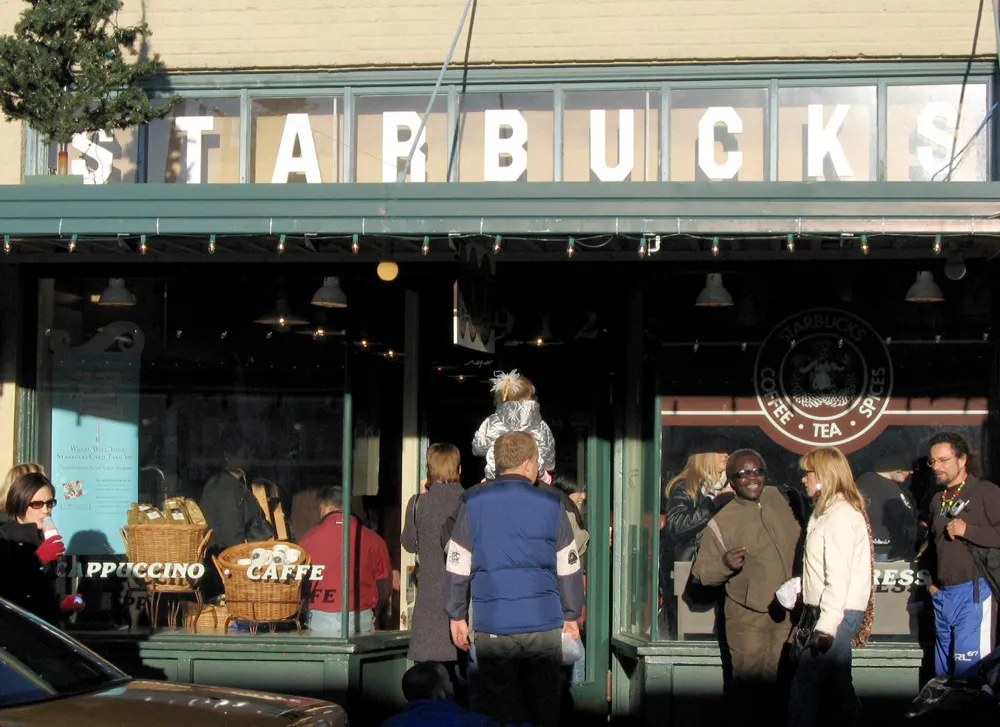
Starbucks opened its first location in Seattle’s Pike Place Market in 1971, initially selling whole coffee beans rather than prepared beverages. Howard Schultz, who joined the company in 1982, is credited with the concept that transformed Starbucks into a global brand: modeling Starbucks stores on the Italian espresso bar, and positioning them explicitly as a “third place” — somewhere between home and work where people could linger, socialize, and feel a sense of community.
Schultz purchased the company in 1987 and led its expansion through the 1990s and early 2000s, during which Starbucks grew from a regional Seattle chain into a global phenomenon, with stores that, at their best, combined consistent quality with a distinctive, unhurried atmosphere that differentiated the brand from convenience-oriented fast food competitors.
Fall
Scaling Away From What Made It Special
Schultz stepped down as CEO in 2000, remaining chairman while new leadership pursued a strategy of rapid, aggressive store expansion, often opening new locations at a pace that prioritized growth targets over the careful site selection and store experience that had defined Starbucks’ earlier years. The company introduced automated espresso machines in many stores, which improved consistency and speed but removed much of the visible craft and theater of manually pulled espresso shots that had been part of the original coffeehouse atmosphere.
Store designs became increasingly standardized and efficiency-driven, and a growing emphasis on drive-thru locations and rapid throughput further eroded the unhurried, community-gathering character that had originally distinguished Starbucks from fast food and convenience retail. Individually, each of these decisions had a defensible operational logic; collectively, they gradually converted many Starbucks locations into something closer to an efficient beverage dispenser than the “third place” the brand had been built around.
In February 2007, Schultz — still chairman, watching the company’s direction from a distance — wrote an internal memo warning that these changes amounted to the “commoditization of the Starbucks Experience.” The memo, intended for internal leadership discussion, was leaked publicly and became a significant embarrassment, but it also crystallized a critique that increasingly matched what customers and Wall Street analysts were beginning to observe in declining same-store sales figures.
Crisis
Declining Sales Meet a Deteriorating Economy
By early 2008, Starbucks was facing a compounding set of problems: same-store sales growth was slowing sharply as the brand-dilution concerns raised in Schultz’s memo began showing up in customer behavior, while the broader U.S. economy was entering the deepening 2008 financial crisis, reducing discretionary consumer spending on premium beverages precisely when Starbucks needed loyal, high-frequency customers most.
The company’s stock price fell by more than half over the course of 2007 and into 2008, reflecting investor concern that Starbucks’ rapid, efficiency-focused expansion had structurally damaged the brand’s premium positioning at the worst possible moment in the economic cycle.
Starbucks’ board brought Schultz back as CEO in January 2008, betting that the founder who had originally built the “third place” concept was best positioned to diagnose which of the company’s recent operational changes had gone too far, and to make the difficult calls necessary to reverse course quickly.
Turnaround
Closing Every U.S. Store for an Afternoon
Schultz’s most symbolically significant early decision was closing all approximately 7,100 U.S. Starbucks stores simultaneously for one afternoon on February 26, 2008, to retrain baristas on proper espresso preparation — a move estimated to cost the company several million dollars in lost sales during the closure window alone. The decision was a deliberate, highly visible statement that Starbucks was prioritizing product quality and craft over short-term throughput, directly answering the critique in the leaked 2007 memo.
Alongside the retraining event, Starbucks closed approximately 600 underperforming U.S. stores and undertook layoffs as part of a broader restructuring, acknowledging that the prior expansion strategy had opened locations in markets or configurations that could not sustain the brand’s premium positioning.
These moves were paired with a renewed focus on the in-store sensory experience that automated equipment and standardized layouts had diminished, including a partial return to practices, such as visible espresso preparation, that reinforced the craft-oriented atmosphere the brand had been built around.
Strategy
Quality First, Then Careful, Deliberate Growth
Rather than abandoning growth altogether, Schultz’s strategy paired the immediate quality-focused fixes with a more disciplined approach to future expansion, prioritizing the health and performance of the existing store base over aggressive new unit growth in the near term. This represented a explicit reversal of the prior decade’s emphasis on rapid store count expansion as the primary growth lever.
Starbucks also extended its brand into new categories carefully, launching VIA instant coffee in 2009 — a product category traditionally associated with lower-quality coffee — while explicitly leveraging Starbucks’ quality reputation to argue the product could meet the same standard the brand had spent decades building, rather than diluting it.
Longer term, the recovery strategy incorporated technology investments, including mobile ordering and a loyalty rewards program, that increased customer convenience and frequency without requiring the kind of physical store standardization that had contributed to the earlier crisis — allowing Starbucks to improve throughput and customer retention through digital channels rather than by further compromising the in-store experience.
“We had to make a decision: Do we want to be a company that is efficient, or do we want to be a company that is loved?”
Leadership
A Founder’s Return, and the Willingness to Reverse His Own Successors
Schultz’s return to the CEO role in 2008 carried a distinctive credibility that an external hire would not have had: he was reversing decisions made by leadership he himself had installed after his first departure in 2000, effectively acknowledging that the growth strategy his own successors had pursued, likely with his implicit endorsement as chairman, had gone further than the brand could sustain.
That willingness to publicly correct course, including through the leaked internal memo and the highly visible store-closure retraining event, required a degree of institutional humility that is uncommon for a founder returning to rescue the company he built, and it lent the turnaround a credibility with both employees and customers that a purely cost-driven restructuring, without that public acknowledgment of what had gone wrong, might not have achieved.
Schultz also used the moment to reassert a values-driven positioning for the brand, framing decisions like the espresso retraining not merely as operational fixes but as a recommitment to the human, community-oriented values the “third place” concept had always been meant to represent — a narrative that helped rally employee morale during a period of layoffs and store closures that could otherwise have deeply damaged internal culture.
Innovation
Innovating Around, Not Against, the Core Experience
Starbucks’ recovery-era innovation was notable for how carefully it avoided repeating the mistake that had caused the crisis: introducing efficiency-oriented changes that quietly eroded the core in-store experience. VIA instant coffee extended the brand into a new, high-margin category without altering the physical café experience at all.
Mobile ordering and the Starbucks Rewards loyalty program, developed and scaled significantly in the years following the initial 2008–2009 stabilization, gave the company a way to increase transaction frequency and customer data insight through a channel entirely separate from the physical store experience, avoiding the tension between speed and atmosphere that automated espresso machines had created in the prior decade.
This distinction between digital-channel efficiency and physical-store experience became a durable strategic principle for Starbucks: use technology to remove friction from ordering and payment, while treating the in-store sensory and service experience as a dimension that should not be compromised for the sake of throughput.
Financial Recovery
From Falling Same-Store Sales to Record Profitability
Starbucks’ stock had fallen by more than half through 2007 and into 2008, reflecting both the brand-dilution concerns raised internally and the deepening broader financial crisis affecting consumer discretionary spending. The initial phase of Schultz’s turnaround, including store closures and layoffs, involved real short-term costs, both in direct expenses and in temporarily reduced sales during the retraining closure.
By 2010 and 2011, as the quality-focused changes took hold and the broader U.S. economy began recovering, Starbucks returned to strong same-store sales growth and record levels of profitability, with its stock price recovering well beyond its pre-crisis levels over the following several years.
The recovery validated Schultz’s central bet: that Starbucks’ brand value was more closely tied to the quality and atmosphere of the in-store experience than to the pace of new store openings, and that protecting the former was a more durable growth strategy than continuing to prioritize the latter.
Lessons
What Starbucks’ Turnaround Still Teaches
Starbucks’ recovery demonstrates that rapid, efficiency-driven growth can quietly undermine the exact qualities that made a brand successful in the first place, even while headline growth metrics like store count continue climbing. The crisis was not caused by a single bad decision, but by the cumulative effect of many individually reasonable efficiency improvements.
The second lesson concerns the power of highly visible, symbolic action in signaling a genuine strategic reset. Closing every U.S. store simultaneously for espresso retraining cost real money and generated real short-term criticism, but it communicated the seriousness of Starbucks’ recommitment to quality far more effectively than a quieter, incremental set of internal process changes would have.
The third lesson is about separating where efficiency should and should not be pursued. Starbucks’ recovery strategy embraced technological efficiency in ordering and payment while explicitly protecting the in-store service experience from further optimization — a distinction that let the company continue improving operational performance without repeating the mistake that had triggered the original crisis.