Rise
The Survivor of the Big-Box Electronics Wars
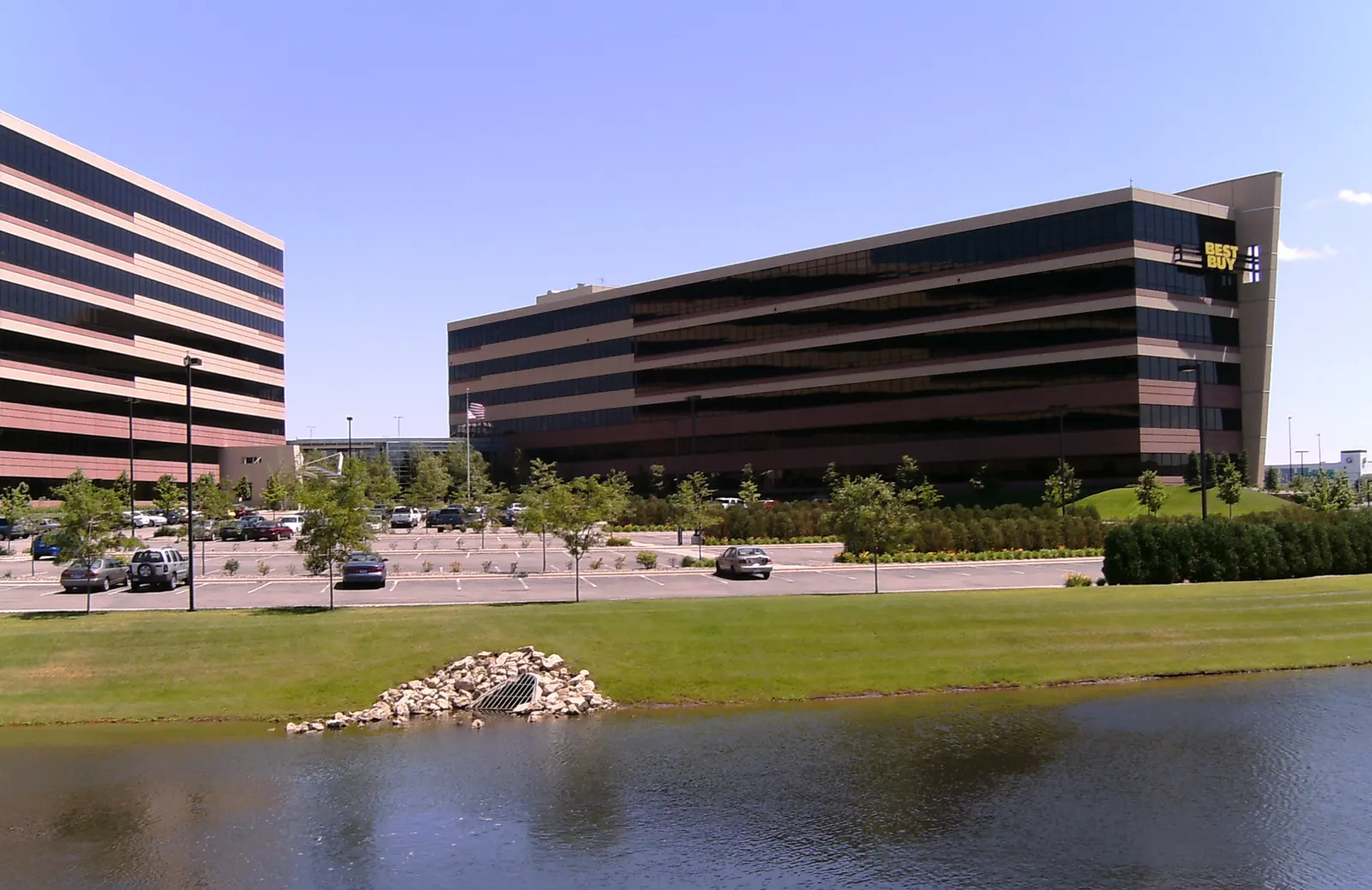
Best Buy traces its origins to 1966, when Richard Schulze founded an audio equipment store in St. Paul, Minnesota, later renamed Best Buy in 1983 as it expanded into a broader consumer electronics retail format. Through the 1990s and 2000s, Best Buy grew into the dominant big-box consumer electronics retailer in North America, a position reinforced significantly by the 2009 liquidation of its largest direct competitor, Circuit City.
For a period following Circuit City’s collapse, Best Buy appeared to have won the big-box electronics retail category decisively. That victory proved short-lived, however, as the threat to Best Buy’s business model shifted from brick-and-mortar competitors to an entirely different kind of competition: e-commerce.
Fall
“Showrooming”: When Your Own Stores Sell for a Competitor
By the early 2010s, Best Buy faced a structural threat that had not seriously existed a decade earlier: “showrooming,” in which customers would visit Best Buy stores specifically to see, touch, and get advice on products, then purchase the identical item online, often from Amazon, at a lower price. Best Buy was, in effect, funding a costly physical showroom and knowledgeable staff for a transaction it frequently did not capture.
The problem was compounded by Best Buy’s cost structure: maintaining a large network of physical stores, with associated rent, staffing, and inventory carrying costs, was fundamentally more expensive than Amazon’s warehouse-and-shipping model, making direct price competition difficult without addressing the underlying cost disadvantage.
Analysts and media coverage increasingly compared Best Buy’s trajectory to Circuit City’s, suggesting the company was following the same slow decline toward liquidation that had claimed its former rival, only this time driven by e-commerce disruption rather than a big-box competitor.
Crisis
A Governance Scandal Compounds a Business Crisis
Best Buy’s business challenges were compounded in 2012 by a serious governance crisis: an internal investigation found that founder and chairman Richard Schulze had failed to properly report CEO Brian Dunn’s inappropriate relationship with a subordinate employee. Schulze resigned as chairman, and Dunn resigned as CEO separately amid the fallout, leaving the company simultaneously managing a leadership vacuum and a deteriorating core business.
Best Buy’s stock fell to roughly $11 per share by December 2012, a steep decline from levels in the $40s just a few years earlier, as investors weighed the compounding effects of showrooming, the leadership crisis, and broader skepticism about whether any big-box electronics retailer could survive Amazon’s growing dominance.
It was against this backdrop — a damaged board, a vacant CEO position, and a business model under direct existential threat from e-commerce — that Best Buy’s board recruited its next chief executive.
Turnaround
Guaranteeing You’d Never Lose on Price
Best Buy hired Hubert Joly, an executive with a background in travel and hospitality at Carlson Companies and no prior experience in consumer electronics retail, as CEO in September 2012. Joly moved quickly to introduce “Renew Blue,” a turnaround plan built around directly confronting the showrooming problem rather than treating it as an unsolvable structural threat.
The plan’s most direct response to showrooming was a price-match guarantee: Best Buy committed to matching prices from Amazon and other major online retailers at the point of sale, removing the primary reason a customer would browse in-store and then purchase online. This was a financially risky move, since it meant accepting lower margins on a portion of sales, but it directly addressed the specific behavior threatening the company’s core business.
Renew Blue also targeted approximately $1 billion in annual cost reductions across the business, streamlining operations and reducing overhead to make the lower-margin, price-matched sales more sustainable, while simultaneously investing in employee training and morale improvements intended to make Best Buy’s in-store expertise a genuine advantage over a purely online shopping experience.
Strategy
Turning Vendors Into Partners, Not Just Suppliers
Beyond price matching, Best Buy’s strategy under Joly restructured its relationship with major electronics manufacturers, striking agreements with Samsung, Apple, Microsoft, and other vendors to build dedicated, branded “store-within-a-store” spaces inside Best Buy locations — with vendors, rather than Best Buy alone, covering a significant share of staffing, fixtures, and display costs.
This arrangement served multiple purposes simultaneously: it gave vendors a controlled, premium retail environment to showcase their products (an increasingly important consideration as Apple and other manufacturers built out their own retail stores), it reduced Best Buy’s own costs for maintaining high-quality product displays and knowledgeable staff, and it gave customers a genuinely differentiated in-store experience that pure e-commerce could not replicate.
Best Buy simultaneously invested in its own e-commerce and fulfillment capabilities, including ship-from-store logistics that used its extensive store network as a distribution advantage rather than treating physical stores purely as a cost center competing against online retail — turning the scale of its real estate footprint from a liability into a logistics asset.
“We had to stop thinking about our stores as a cost problem and start thinking about them as our biggest competitive advantage.”
Leadership
An Outsider’s Focus on Employee Morale
Hubert Joly’s lack of a consumer electronics retail background is frequently cited as an asset rather than a liability in Best Buy’s recovery: he approached the crisis without preconceptions about what a big-box electronics retailer had to look like, and was willing to fundamentally restructure vendor relationships and pricing policy in ways an industry veteran might have found harder to justify internally.
Joly placed unusual emphasis, for a retail turnaround, on employee engagement and morale, visiting stores directly and prioritizing frontline staff training, based on the conviction that knowledgeable, motivated employees were central to making Best Buy’s physical stores a genuine advantage over online-only competitors rather than merely a cost to be minimized.
This leadership approach required navigating the immediate aftermath of the Schulze-Dunn governance scandal carefully, rebuilding trust with a board, employee base, and investor community that had been shaken by a leadership crisis layered directly on top of an already severe business challenge.
Innovation
Making Physical Retail Amazon Couldn’t Replicate
Best Buy’s central innovation was reframing the competitive question from “how do we compete with Amazon’s prices” to “what can a physical store offer that pure e-commerce cannot” — and then building the vendor showcase partnerships, staff training, and price-match guarantee needed to make that reframing commercially real rather than aspirational.
The vendor “store-within-a-store” model was a genuine structural innovation in big-box retail, aligning the incentives of manufacturers, who wanted premium physical showcases for their products, with Best Buy’s need to reduce its own costs for maintaining a compelling in-store experience — a partnership structure that has since been referenced as a model for other retailers navigating similar e-commerce pressure.
Best Buy’s ship-from-store fulfillment innovation similarly converted what many analysts had treated purely as a cost disadvantage — a large network of physical stores — into a logistics advantage, allowing faster delivery to nearby customers than a purely centralized warehouse model could offer.
Financial Recovery
From a Circuit City Comparison to a Top-Performing Stock
The market’s reassessment of Best Buy’s prospects under the Renew Blue plan was rapid. Having fallen to roughly $11 per share in December 2012, Best Buy’s stock became one of the best-performing stocks in the S&P 500 during 2013, more than doubling as early evidence emerged that the price-matching and vendor-partnership strategies were stabilizing sales and improving margins.
Best Buy exceeded its original Renew Blue cost-savings targets, reaching roughly $1 billion in annual reductions, while stabilizing same-store sales that had been declining before the turnaround began — a combination that directly refuted the widespread prediction that Best Buy would follow Circuit City into liquidation.
The turnaround’s success also proved influential well beyond Best Buy itself, offering a rare example among traditional big-box retailers of a company successfully adapting its physical retail model to coexist with, rather than simply lose to, e-commerce competition — a template subsequently referenced by other retailers facing similar structural threats.
Lessons
What Best Buy’s Turnaround Still Teaches
Best Buy’s recovery demonstrates that a specific, well-defined competitive threat — showrooming — can often be addressed with a direct, if financially uncomfortable, countermeasure (price matching) rather than requiring an entirely new business model. The company did not abandon physical retail; it removed the specific reason customers were using its stores without buying from it.
The second lesson concerns realigning vendor incentives during a crisis. Rather than treating manufacturers purely as suppliers, Best Buy restructured its relationships to share the cost and responsibility of creating a compelling in-store experience, a partnership model that reduced Best Buy’s own financial exposure while improving the customer experience simultaneously.
The third lesson is about reframing a perceived structural liability as a potential asset. Best Buy’s large physical store footprint was widely viewed as a cost disadvantage relative to Amazon’s warehouse model; the turnaround succeeded partly by finding ways — vendor showcases, ship-from-store fulfillment — to make that same footprint a genuine competitive advantage instead.